KEEP VICTORIA FALLS WILD

KEEP VICTORIA FALLS WILD
Save Victoria Falls from over-development - click to visit site - www.keepvictoriafallswild.com
Showing posts with label david livingstone. Show all posts

Thursday, 12 May 2022

Legends of the Falls (Part 2): The Place of the Rainbow

Legends of the Victoria Falls (Part 2): The Place of the Rainbow

By Peter Roberts

The second part in a short series looking at the cultural and natural history of the Victoria Falls, a natural wonder of the world and UNESCO World Heritage Site.

The first article looked at the cultural traditions recorded by Livingstone on his visits to the Falls in 1855 and 1860 (available here). Now we look at how, fifty years later, the Victoria Falls were promoted to and perceived by early tourists, and how Livingstone himself now became part of the local legend of the Falls.

Part One available here: 

Legends of the Victoria Falls (Part 1): Spirits of the Falls.


Victoria Falls

Victoria falls viewed from western end, Cataract Island in foreground
 (Photo Credit: Peter Roberts)

Guiding Spirits

In 1902 Mr Francis (Frank) William Sykes was appointed the first Conservator of the Falls, responsible for the Falls Park established on both sides of the river around the immediate area of the Falls for a distance of five miles. Sykes appears to have spent some time trying to understand the local traditions and cultural beliefs surrounding the Falls.

The travel writer and correspondent for the London Morning Post, Mr Edward Frederick Knight, visited the Falls in early 1903, publishing a detailed account of his travels later the same year. Sykes guided Knight around the Falls, spending the first day exploring the north bank and the second day the south side.

Viewing the Falls from the Eastern Cataract Knight recorded his first impressions.

“It is too sublime a spectacle to have anything of horror in it. The sense of danger is strangely absent as one looks from the edge of the abyss at the majestic scene. It is as if one were out of this universe and in some higher one where the forces of Nature are on a gigantic scale, irresistible yet without menace; where there is no death or pain for living things, so that they are able to gaze with a rapture of admiration unmixed with fear at the stupendous and beautiful manifestations of power that cannot hurt them. At the Victoria Falls the traveller feels that he might well be looking on some landscape of Paradise.” (Knight, 1903, p.344)

The next day they explored the Falls from the south bank, and into the 'rainforest' (so named by the German visitor, E Mohr in 1870) opposite the main falls.

At the western end of the Falls Knight recorded a tradition of tying the long grass into a knot as a 'petition to the spirits':

“We followed the canon cliff round its westernmost curve, and I noticed that the tufts of grass growing at the very brink of the abyss had been tied at the top into knots by the natives, so that they had the appearance of so many ninepins. Each of these knotted tufts was a petition to the spirits of the Falls, for the Barotse feel the awful influence of the cataract, and in recognition of and in supplication to the mystic power of the water they fashion these living prayers.” (Knight, 1903, p.349)

Sykes' knowledge of local beliefs perhaps influenced Knight in his descriptions, particularly in relation to the rainbows which follow the observer at close distance during certain conditions in the dense atmosphere of the rainforest, and which Knight likened to 'an attendant ghost,' an echo perhaps of the traditional cultural beliefs associating the rainbow with the guiding spirits of the ancestors and the resulting spiritual significance of the Falls (See: Legends of the Victoria Falls (Part 1): Spirits of the Falls).  

Then we plunged into the Rain Forest itself, and here, though there were some open savannahs of grass and fern, the growth of trees and bush was generally so dense that we could only progress by following the many intersecting hippopotamus tracks, tunnels which these animals had forced through the vegetation, down which we had to crawl, wading through deep mud and rank sodden grass, and crossing many streams of running water made by the falling spray...

It was a forest of eternal driving wind and rain; and yet, despite this, it was no dark, cheerless, stormy scene that surrounded us. We walked through an atmosphere that was bright and luminous and even dazzling to our eyes. For, from the cloudless blue above us, which we could not see, the fierce rays of the sun pierced the spray cloud, filling the air with a diffused watery ever-shifting light. It was as if the sunshine were pouring on us through a veil of thin white silk.


Victoria Falls

Viewed through the rainforest (Photo Credit: Peter Roberts)

"In this light the raindrops on all the leaves sparkled like jewels. As we walked on there was always on the right hand of each of us a bright rainbow following him wheresoever he went like an attendant ghost. When we were in the more open spaces these rainbows retreated to a long distance off and waxed larger, appearing to span leagues of country; but when the forest closed in on us they came nearer and were smaller, in the denser jungle narrowing to arcs of colour not a yard across and so close that it seemed as if one had but to stretch out one's hand to touch them...

And now that we were in the midst of the forest we realised all the unsurpassed luxuriance of this tropical vegetation bathed in sunshine and everlasting rain; the vivid greenness of the great trees, whose branches were linked with the multitudinous tendrils of the lianes and convolvuli; the lushness of the grass and ferns; the wondrous beauty of the various delicate flowers with rainbow-tinted petals, frail-looking but unharmed by the endless storm, marvellous blossoms that one was loth to pick. We plucked a few, hoping to keep them as specimens, but found that they almost immediately faded and withered in one's hand like the flowers of the enchanted garden of the fairy tale. And this might, indeed, have been a garden of fairyland, so unreal and dreamlike it looked in that luminous atmosphere...

And yet ever by our side, advancing when we advanced, stopping when we stopped, were the faithful little attendant rainbows, brightening and waning with the changing density of the water-wind that swirled around us...

And so on we went, drenched, for no waterproofs will keep one dry here, now under the dripping trees, now over the soaked savannahs, and now clambering over the slippery rocks on the cliff edge, until we had traversed the whole length of the Rain Forest and had come to the most terrible spot of all. We were standing at the extremity of that great wedge-shaped promontory of rock called Danger Point...

We might have been gazing at a primordial chaos from which some day, after the passing of aeons, a world would be created. On this wild cape the air was no longer luminous, as in the forest; the sun’s rays did not pierce the dense vapours; the faithful little rainbows were unable to follow us here, and had left us.” (Knight, 1903, p.353-356)

The Place Where the Rain is Born

Fifty years after Livingstone's first visit to the Falls, Sykes authored the first ‘official’ tourism guide on the Falls, published during late August 1905. Sykes introduced his guide with the arrival of Dr Livingstone at the Falls in 1855, and records several local names and their meanings.

“The Native (Sekololo [Makalolo]) name for the Falls is Mosi-oa-Tunya, meaning ‘the smoke which sounds.’ It is a most appropriate one, as, viewed from any of the surrounding hills, this rising columns of spray, more particularly on a dull day, bear an extraordinary resemblance to the smoke of a distant veldt fire... The native in their songs say ‘how should anyone lose his way with such a land-mark to guide him?’” (Sykes, 1905)

Cataract Island is given its now commonly used English name, with Boruka as “the native name, signifying ‘divider of the waters.’”

On Livingstone Island Sykes wrote:

“Situated on the edge of the chasm almost in the centre of the Falls is the Island named after David Livingstone. ‘Kempongo’ was the old native name, which means ‘Goat Island.’ He himself named it Garden Island. It is a curious coincidence that it should bear a similar name to that other island which occupies almost an identical position at Niagara.” (Sykes, 1905)

Of the Rainforest, first named by the German traveller Edward Mohr who visited in 1870, Sykes notes:

“The name is well chosen, for here it is always dripping. The natives themselves refer to it as 'the place where the rain is born.'” (Sykes, 1905)


Victoria Falls

Cataract Island (Photo Credit: Peter Roberts)

At the end of the guide Sykes listed the regulations which visitors were expected to follow for the protection of the Falls environments, detailing the prohibiting of:

“- Shooting of any and every description within a radius of five miles [8 km] of the Falls on either bank.

- Netting and dynamiting in the river.

- The cutting of initials on or other defacement of the boles of trees.

- Plucking of flowers and ferns, uprooting ferns, orchids or other plants.

- Setting fire to the grass in the park.

- Trespassing of animals.

- Washing of clothes in the river above the Falls.

- Picnic parties are requested to remove all traces of their presence, such as tins, bottles, paper, etc, before leaving.

“The importance of the above will be obvious to all visitors who are lovers of nature, and their loyal observance is confidently relied upon.” (Sykes, 1905)

The regulations protecting the environment of the Falls not only protected the Falls and its immediate surrounds from the actions of indiscriminate visitors, but also limited access to, and the use of, the river and Falls for local Leya people, including access to sacred shrines and sites around the Falls - the prohibition of the washing of clothes in the river apparently directed specifically at the cleansing rituals carried out in the natural pools on the lip of the Falls. 

A New Shrine

A few months previously, in late 1902, Sykes had visited Garden Island with a local elder, Namakabwa, who showed him the tree upon which Livingstone had carved his initials, and which were said to still be faintly visible. Sykes later recorded its rediscovery:

“The Name Tree upon which he cut his initials still remains. Its identity was determined two years ago by the writer... An old white-haired native, by name Namakabwa, who spent most of his time down the gorge catching fish, on being questioned said he well remembered Livingstone, whose native name was ‘Monari,’ coming to the Falls, and described how he (Namakabwa) a day or two after Livingstone’s departure, made his way over to the island and found that a small plot had been cleared of bushes, also that he had made some cutting on a tree. When asked ‘which tree?’ he immediately went to the Name Tree, and put his finger on what had evidently been a cut. The authenticity of the above then is based on the evidence of ‘the oldest inhabitant,’ and may be accepted as genuine. The bark of the tree is so rough and the marks so nearly obliterated that one would have had some doubts on the subject, were the source of information less worthy of belief.

“It is to be recorded with regret that a certain class of tourists, to whom nothing is sacred, had commenced to strip and carry away pieces of the bark from this tree, and so came the necessity for a notice-board and tree-guard, in themselves a witness against the relic hunting vandal who lightly destroys what can never be replaced. Even Livingstone, the discoverer of the Falls, excuses himself for ‘this piece of vanity.’ Would that others were only as sensitive on this point as the great explorer, and delay carving their meaningless initials on the trunks of trees until they can boast such a world-wide fame as was his to excuse the act!” (Sykes, 1905)

The Livingstone Tree

The Livingstone Name Tree (Image from early postcar)

The railway line from the south to the Victoria Falls was completed in April 1904, and soon after, in June, the Victoria Falls Hotel opened its doors to its first guests. Construction of the Victoria Falls Bridge started later the same year, with the official opening held in September 1905.

Tours to Livingstone Island, and a visit to the 'Livingstone Name Tree,' were a key part of a visit to the Falls for early visitors. In January 1906, however, it was reported that there were fears tree was dying.

"The Livingstone correspondent of the Bulawayo Chronicle states that the tree upon which Dr Livingstone carved his initials at the Victoria Falls, is dying, and it is proposed to cut down the trunk and send it to London to be preserved with other relics. It is further proposed to perpetuate the memory of the great explorer by erecting a monument on the spot where the tree now stands.” (News from Barotsiland, 1906)

When the now famous bronze statue of David Livingstone was unveiled overlooking the western view of the Falls in August 1934, news reports recorded Livingstone’s initials were apparently still faintly visible on the tree he had originally carved them into in 1855, although by now serious doubts were being expressed as to the authenticity of the marks and even the identification of the tree itself.

References

Knight, E. F. (1903) South Africa after the War, A Narrative of Recent Travel. Longmans, Green and Co, London.

Sykes, F. W. (1905) Official Guide to the Victoria Falls. Argus Co., Bulawayo.

News from Barotsiland (1906) No.27, January 1906. p.8.

 - - -

Cataract Island Under Threat of Tourism Development

The sacred island sanctuary and protected wildlife refuge of Cataract Island is threatened by the recent launch of tourism tours and activities to the island, endangering not only its fragile ecology but also the wider status of the Falls as a World Heritage Site.

Read more: Fears Grow Over Falls World Heritage Status

- - -

Peter Roberts is an ecologist, conservationist and freelance researcher and writer with a special focus on the Victoria Falls region. He is author of several books on the history of the Falls, including 'Footsteps Through Time - a history of Travel and Tourism to the Victoria Falls' [First published in July 2017, revised third edition April 2021].

Friday, 31 October 2014

Dr Livingstone's Lost Beetle Collection Discovered


17-10-2014

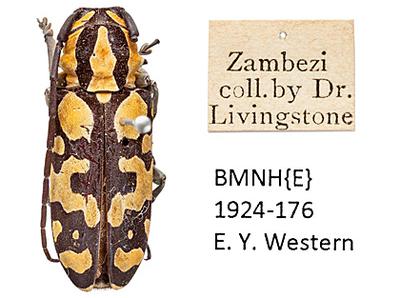
LONDON: The curator of the Natural History Museum has stumbled upon an unparalleled treasure - a unique collection of insects gathered by Dr David Livingstone, one of Britain's legendary explorers of Africa, which has remained hidden for over 150 years.

It is the only known collection of beetle specimens belonging to the explorer which he brought back from Africa. The 20 specimens date back to Dr Livingstone's expedition along Africa's Zambezi River, which ran from 1858 to 1864.
Experts were unaware that the renowned British explorer had collected beetles until now. The specimens were unearthed by curators cataloguing and photographing the Museum's collection for its online database. They came across an unusual box and when they opened it they discovered that Dr Livingstone's name and the name of the Zambezi expedition were written on the specimens' labels.

Max Barclay, the museum's beetle curator, found the box among thousands of others containing uncategorised material as he sought to catalogue parts of the collection online. Inside was a label that said "Zambezi coll. by Dr. Livingstone". The insects were donated to the Museum by a private collector, Edward Young Western, in 1924. He is thought to have bought them directly from a member of the Zambezi expedition. In the days before digital records, they got lost among the Museum's 10 million beetle specimens and sat unnoticed for 90 years.

Museum beetle curator Max Barclay, who made the discovery, said it was a complete surprise and one of great historical and scientific importance. "We have 22,000 drawers of beetles and every drawer is like a treasure chest waiting to be opened. You can never imagine what you will find inside," he said. "Historically, it is very exciting that these specimens have been preserved. No biographers mention Dr Livingstone collecting beetles - it is an aspect of the well-known explorer that was previously unknown".

There are 12 different beetle species in the box including the giant predatory ground beetle, Termophilum alternatum, the variegated golden longhorn beetle, Tragocephala variegata, and the flightless spiny longhorn beetle, Phantasis avernica.

Barclay said that the specimens are already shedding light on the effects of environmental change in the Zambezi region.

Museum entomologist Hitoshi Takano recently led a number of expeditions retracing Dr Livingstone's footsteps across Africa's interior. During his travels he came across many of the same beetle species that Dr Livingstone spotted 150 years before. Barclay said "The fact that most of the same species can still be found in Zambezi today means that the environments in the area might have changed less than we expected. Or, against all odds, many species from Dr Livingstone's day still remain despite 150 years of habitat destruction and deforestation".

But one species of beetle collected from Zambezi by Dr Livingstone was not found in the region during Takano's expeditions. This could be evidence of the effect of environmental changes, said Barclay: "It is possible that this species has declined or been lost from the region. Insects are often like the canary in the mine - their decline warns us about environmental changes that we may not have easily noticed". Barclay said that before digital records were introduced knowledge was often lost between generations, but Dr Livingstone's beetles will be valuable sources of information for scientists for years to come.

"We can learn so much from them. Old specimens are a little bit like a fossil record of the environment at a past time. We are discovering things that our great-grandparents' generation may have known, but the information was never passed down. Nowadays we record this information on databases and online, so it will be preserved for future generations".

Dr Livingstone, a Scottish missionary and one of the first European explorers of Africa, died in Zambia in 1873, aged 60.

Source: Dr Livingstone's Collection Discovered (Oct 2014)

Monday, 25 March 2013

On the Old Hunter's Road


On the banks of the Linyanti
Image Credit: Tom Varley
Written by Peter Roberts for the Zambezi Traveller
At the turn of the last century Victoria Falls had only just appeared on the tourist map. Only known to the wider world since 1855, when David Livingstone made their existence popular knowledge, to reach the Victoria Falls required an expedition of many weeks, if not months, travelling overland by ox-cart along rough tracks through thick bush inhabited by wild and dangerous animals. Explorers, hunters and traders all made tracks towards the Falls, and before long a wagon road ran from the south. The Old Hunters’ Road, as it became known, now forms the border between Botswana and Zimbabwe.
Read full article in March issue of the Zambezi Traveller or online on the Zambezi Traveller website (external link, openins in new window).
Read more about the history of the Victoira Falls online here: To The Victoria Falls (external link, openins in new window).


Tuesday, 19 March 2013

Livingstone's Legacy

Today is the 200th anniversary of David Livingstone's birth, in Blantyre, Scotland.

This year the Zambian town which still bears his name celebrates the missionary turned explorer's life and achievements with a series of special events.

Read more here.

For some interesting perspectives on Livingstone's life see the following links.

Dr Livingstone and the cult of Victorian celebrity
Daily Telegraph, 20 March 2013

Today marks the bicentenary of the birth of Dr Livingstone, the missionary-explorer worshipped as a near-saint. In reality he was a cruel parent and husband and, though he achieved much, owed his saintly reputation to the media.

Read more: The Daily Telegraph.

The African chief converted to Christianity by Dr Livingstone
BBC News, 19 Mar 2013

...200 years since the birth of David Livingstone, perhaps the most famous of the missionaries to visit Africa in the 19th Century. But as author and Church historian Stephen Tomkins explains, the story of an African chief he converted is every bit as incredible as Livingstone's.

Read more: BBC News.

In the footsteps of Livingstone
The Daily Telegraph, 13 Mar 2013

As Dr Livingstone's bicentenary approaches, the explorer John Blashford-Snell considers the enduring legacy of the Scotsman and his travels.

Read more: The Daily Telegraph.

Dr Livingstone 'lied in famous account of slave market massacre'
The Daily Telegraph, 02 Nov 2011

Dr David Livingstone may have lied about his famous account of a slave market massacre, a new study into a faded 140-year-old diary has suggested.

Read more: The Daily Telegraph.

Dr David Livingstone
To The Victoria Falls

A Scottish medical missionary and explorer would be the first to make two important discoveries regarding the Zambizi river. Dr David Livingstone was the first to realise that the upper section of the river became the Zambezi known from the east coast, and the first to see the magnificent Victoria Falls, naming them after his British Queen and making them known to the world.

Read more: To The Victoria Falls.

Monday, 4 February 2013

David Livingstone and the ‘discovery’ of the Victoria Falls

2013 marks the 200th anniversary of David Livingstone's birth. Last year, on the 157th anniversary of his 'discovery' of the Victoria Falls, we looked at Livingstone and his legacy in relation his most famous discovery for the Victoria Falls Guide (all articles researched and written by Peter Roberts).
David Livingstone and the ‘discovery’ of the Victoria Falls
For more detailed backgrund on David Livingstone and his Zambezi travels see To The Victoria Falls.
Photo Credit: David Livingstone (To The Victoria Falls)


Friday, 14 December 2012

Livingstone's Lechwe

When David Livingstone reached Linyanti on the banks of the Chobe in 1851, he not only found the upper reaches of the Zambezi, but also large numbers of a species of spiral-horned antelope specially adapted to the seasonally flooded marshlands, the lechwe (Kobus leche). Livingstone had been the first to describe this species to science when he became the first European to reach Lake Ngami in 1849, and he later discovered another subspecies when he travelled upstream and into Kafue Flats.
Read more: The Zambezi Traveller: Livingstone's Lechwe
Photo Credit: Zambezi Traveller

Monday, 2 August 2004

Dr Livingstone's statue is ours, we presume, Zambia informs Mugabe

A life-sized bronze of Dr David Livingstone has stood overlooking Victoria Falls for more than half a century. But after years of neglect by its current owners, the Zimbabwean government, Zambia is calling for the statue to be handed over to them.
The figure of the Victorian explorer, leaning on his walking stick, has stood on the Zimbabwean side of the falls and been seen by hundreds of thousands of visitors each year to one of the seven natural wonders of the world.
Recently, however, as political turmoil in Zimbabwe has deepened, tourists have switched in increasing numbers to the Zambian side of the falls - while two years ago the statue, seen as a symbol of British colonialism, was defaced by thugs of Robert Mugabe's regime.
Now the authorities in Zambia want to cap their success by making the figure of Africa's most celebrated explorer the centrepiece of the town of Livingstone, where the tourist trade is booming.
"The Zambians have a great deal of affection for Livingstone's memory, unlike the Zimbabweans," said Siloka Mukuni, the chief of the Leya people, who live around Livingstone. "We have changed a great many of our colonial place names since independence, but we have kept the name of Livingstone out of a deep respect. For Zimbabwe the statue merely represents tourism and money. We would like the statue, but we would prefer not to fight over it."
It was from the Zambian side of the Zambezi river in 1855 that Dr Livingstone became the first European to sight the falls, then known locally as Mosi-oa-Tunya - "The smoke that thunders".
Some older Leya people claim that the statue was originally erected on their side of the Zambezi - then the British colony of Northern Rhodesia - but was moved during the 1950s to its present site overlooking the Devil's Cataract, on what is now the Zimbabwean side.
"I have 80-year-old advisers who clearly remember the statue being on our side of the river," Chief Mukuni said. "It was there and then it was gone, reappearing in Zimbabwe."
Others say there may have been a second statue depicting the explorer shielding his eyes from the sun, on the Zambian side of the falls, which is now missing.
Either way, Zambia is keen to get its hands on the bronze, sculpted in the 1930s by Sir William Reid Dick, before next year's 100th anniversary of the town of Livingstone, when it will also be 150 years since the Victorian explorer first saw the falls. The Zimbabwean government has signalled, however, that it has no intention of handing the statue over.
Now Donald Chikumbi, a senior official at Zambia's National Heritage Conservation Commission, has asked the Foreign Office in London and the British High Commission in Lusaka to help get to the bottom of the mystery. "Ideally, we would like to have the Victoria Falls statue, but obviously we have a stronger case if we can show that it was originally in Zambia. What is clear is that Zimbabwe does not want us to have it," he said.
Once Africa's most popular tourist destinations, the town of Victoria Falls has fallen out of favour in recent years. Hotel occupancy has plunged from 70 per cent to below 30 per cent.
Victoria Falls' losses, however, have been Livingstone's gain. A string of new hotels has sprung up since 2000, when Mr Mugabe began his violent land-grab policy, and occupancy rates have risen sharply.
Tendai Shoku, Zimbabwe's High Commissioner to Zambia, said that the dispute would be resolved "bilaterally".
"Zimbabwe and Zambia are just brothers - we are actually one. Let not this issue separate us," he said. "The habit of bringing confusion is for the British who even in the times of Rhodesia called us Southern and Northern, as if we were different. We are not."